
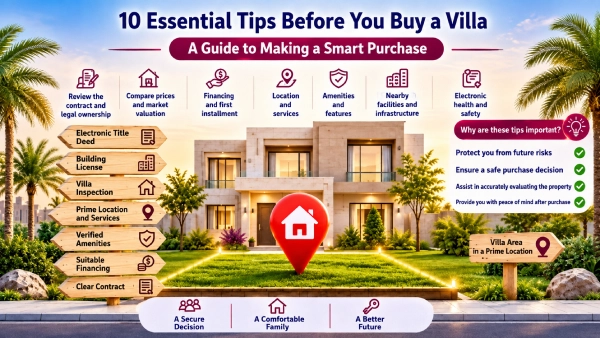
The most important tips before buying a villa are verifying the validity of the electronic title deed, the building permit, the occupancy certificate, the finishing quality, the latent defects insurance policy, the suitability of the location and services, your capacity to handle the financing, and the fairness of the price. After that, you must officially review the contract and the ownership transfer mechanism before paying a deposit or signing.
Buying a villa is a decision tied to your family’s stability for years; it is not merely a comparison of the number of rooms or the shape of the facade. Therefore, the decision must begin with official documents, followed by a technical inspection, and then a thorough study of the location, financing, and the contract.
This list explains the essential tips before buying a villa and how to practically verify each item before making any financial commitment.
محتوى المقال
Top Tips Before Buying a Villa: What is the Checklist You Need?
The basic checklist consists of ten items covering the legal status of the property, building quality, neighborhood suitability, and the true cost of the purchase. It is not enough for the seller to answer verbally; you must request the document and verify its data through the competent official authority.
1. How to Ensure the Validity of the Electronic Title Deed (Sak)?
Start by requesting the property ownership document number and its date, then compare the owner’s name, property area, boundaries, and location with the data provided in the offer and the contract.
The Ministry of Justice provides a service to inquire about a real estate ownership document via the Real Estate Exchange (Boursa) platform. The service displays details of the document, the owner, and the property after entering the required deed data.
Verify the following points:
- The owner’s name matches the party signing the sales contract.
- The plot number, master plan, and area match exactly.
- No discrepancy in the property description between the deed and the contract.
- Clarification of any mortgages or active restrictions on the property.
- The existence of a valid real estate power of attorney if the seller is represented by an agent.
Do not transfer a deposit to the account of a person whose identity does not appear in the title deed, power of attorney, or the official brokerage contract.
2. How to Verify the Building Permit and Occupancy Certificate?
Request a copy of the building permit and its number, then verify it via the building permit inquiry service on the “Balady” platform. Afterward, request the building’s Occupancy Certificate (Certificate of Completion), rather than settling for a verbal confirmation that the building is complete.
The building permit outlines the approved design, usage, and areas, while the occupancy certificate is tied to the completion of the building’s procedures and their approval by the municipality.
Compare between:
- The land area in the title deed.
- The built-up area in the permit.
- The number of floors and annexes.
- Setbacks and facades.
- Any additions or modifications executed after the permit was issued.
A discrepancy between reality and the permit requires an official clarification before purchasing, so that a regulatory problem does not transfer to you after the ownership transfer (Ifragh).
3. How to Inspect the Facade Orientation and Villa Location Within the Neighborhood?
The facade orientation is not a superficial detail; it can affect sunlight entry, room temperatures, privacy, entrance locations, and the usability of the living room and yard throughout the day.
Match the property’s orientations and boundaries with the title deed and the approved survey sketch, then visit the site at different hours. Do not rely solely on the advertisement photo or the map orientation.
During the inspection, verify:
- The orientation of bedrooms and windows.
- The facade’s exposure to the sun during daylight hours.
- The privacy of windows and living rooms (Majlis).
- The villa’s proximity to intersections or crowded roads.
- The location of parking spaces and ease of entry/exit.
- The presence of empty lands whose use might change in the future.
4. How is a Villa Inspected Before Purchase?
A pre-purchase villa inspection should cover visible structural works, insulation, plumbing, electricity, air conditioning, doors and windows, floor leveling, and water drainage.
Hire an independent, licensed engineering office. You can verify engineering offices and their classifications via the Balady platform or the Saudi Council of Engineers.
It is preferable that the office provides a written report including:
- Visible structural observations.
- Signs of moisture or water leaks.
- Integrity of roofs and insulated areas.
- Water pressure and bathroom drainage.
- The electrical panel, breakers, and outlets.
- Floor slopes and balcony drainage.
- Sealing and closing mechanisms of doors and windows.
- Defects that must be repaired before handover.
An occupancy certificate is not a substitute for the inspection you request as a buyer; each procedure has a different purpose.
5. What to Review in Villa Finishing and Warranties?
Review the written finishing specifications, not just the visual impression. Ask about the types of materials and appliances installed, the executing party, and the available invoices or warranty certificates.
Verify:
- The type of sanitary ware and mixers.
- The type of doors, windows, and glass.
- Waterproofing and thermal insulation specifications.
- AC units and whether they are included in the price.
- The quality of paints and flooring.
- Warranties issued by suppliers and contractors.
- The method for logging maintenance requests after handover.
Document any agreed-upon repairs in a written handover protocol or addendum, and specify who is responsible for executing them before the deed transfer or handover.
6. How to Verify the Latent Defects Insurance?
Request a copy of the latent defects insurance policy associated with the building. Verify the policy number, the covered property, the start date of coverage, the scope of protection, exclusions, and the claim submission mechanism.
The Balady platform clarifies that the latent defects insurance policy is linked to the building permit issuance procedures for non-governmental buildings, and the policy’s activation occurs after the occupancy certificate is issued.
Do not settle for “There is a warranty.” Ask specifically:
- Is the warranty issued by an insurance company or just the contractor?
- What structural elements are covered?
- When does the coverage start?
- What cases are excluded?
- How do you submit a claim?
- Do the policy’s rights transfer to the new buyer?
7. How to Set a Financing and Down Payment Plan?
Before signing, request a written financing offer from a licensed entity, then compare the total financing amount, the Annual Percentage Rate (APR), the total payable amount, fees, the monthly installment, and early repayment terms.
The Saudi Central Bank (SAMA) rules require the real estate financing contract to disclose elements including the term cost, APR, and the total amount payable by the beneficiary.
Do not compare financing offers based solely on the installment value. An installment might be lower due to a longer duration, making the final cost much higher.
Also calculate:
- The down payment.
- Valuation fees.
- Administrative expenses.
- Required insurance costs.
- Moving and furnishing costs.
- Maintenance expenses after handover.
- Your ability to afford the installment if family financial obligations change.
8. How to Verify Services and Infrastructure?
Do not rely on the presence of services in a marketing brochure alone. Inspect the site and request proof of the readiness of each service for the unit you intend to buy.
Verify:
- The electricity meter and its status.
- Water connection or supply method.
- The sewage network.
- Rainwater drainage.
- Lighting of surrounding roads.
- The condition of streets and sidewalks.
- Proximity to schools, mosques, and shops.
- Availability of sufficient parking for the family and guests.
Rawafed’s website publishes that its projects in the Al-Jassah neighborhood include services such as electricity, water, sewage, schools, mosques, parks, and pedestrian walkways. However, the buyer must confirm the service status for the specific unit at the time of inspection.
9. How to Evaluate the Neighborhood and Tranquility Before Buying?
One midday visit is not enough to judge a neighborhood. Visit the villa in the morning and evening, on a workday, and on a weekend. Observe the traffic, noise, ease of parking, and entry into the home.
Ask about:
- Traffic density during rush hours.
- Nearby commercial activities.
- School locations and congestion times.
- Empty lands and projects under construction.
- The level of privacy between villas.
- Street cleanliness and lighting condition.
- Ease of commuting to work and daily services.
10. How Do You Know the Villa’s Price is Fair for the Market?
Compare the villa with similar properties in the same neighborhood, not just any villa offered in the city. The comparison must be close in property type, land and built-up area, building age, finishing quality, and location within the neighborhood.
The Real Estate Indicators Platform of the General Real Estate Authority provides updated data on prices and transactions, with the ability to filter by location, property type, and timeframe. Use the platform to understand the market trend, then request a real estate valuation from a certified appraiser when the transaction value or financing terms require it.
Do not make the advertised price your only reference; the asking price may differ from the prices at which actual transactions were executed.
11. What to Review in the Contract and Deed Transfer (Ifragh) Procedures?
Although this list contains ten main pillars, reviewing the contract and the deed transfer mechanism is the step that brings them all together before final signing.
The contract must clearly include:
- Property and title deed data.
- The price and payment method.
- The deposit amount and conditions for its refund.
- The date of deed transfer and handover.
- Appliances and fixtures included in the sale.
- Repairs required to be executed.
- Responsibility for fees and obligations.
- How to handle financing delays or rejections.
- Warranties that will be handed over to the buyer.
- Dispute resolution methods.
The Ministry of Justice offers a service to list a real estate transaction for ownership transfer via the Real Estate Exchange platform. The procedures include selecting the property and reviewing its data and transaction details before approval.
Also, verify the real estate broker’s license via the General Real Estate Authority’s broker inquiry service before paying a commission or signing a brokerage contract.
What Questions Must You Ask the Seller Before Signing?
Use the following questions during the inspection, and request written answers or documents when the question relates to a regulatory status or warranty:
- What is the title deed number, and how can I verify it?
- Is the property mortgaged or restricted in a way that affects ownership transfer?
- What are the building permit and occupancy certificate numbers?
- Are there additions not listed in the permit?
- Can I use an independent engineering office to inspect the villa?
- What defects or repairs were previously executed?
- What warranty documents are available for the works and appliances?
- Is there a latent defects insurance policy specific to the building?
- What services are actually connected to the unit?
- What does the price include in terms of ACs, kitchens, or appliances?
- What is the mechanism for paying and refunding the deposit?
- When will ownership be transferred and the villa handed over?
- Who bears the fees and expenses related to the transaction?
- Are there any existing financial obligations or fees on the property?
- What is the broker’s license and brokerage contract number?
Keep a copy of the offer, correspondence, and documents; they will help you match what you were promised with the final contract.
How to Gain Peace of Mind When Buying a Villa from Rawafed Real Estate?
Peace of mind does not come from an advertisement, but from the seller’s readiness to display documents, allow inspections, and answer questions clearly.
Rawafed Real Estate offers villas in the Al-Jassah neighborhood in Madinah, noting the availability of ready title deeds, official building permits, and site services. The villas page also displays two models that can be compared based on family needs:
- Orchid Model: Published land area of 225 m² and built-up area of 341 m².
- Rose Model: Published land area of 220 m² and built-up area of 334 m².
During the viewing, request to see the documents for the available unit, including the title deed, permit, occupancy certificate, insurance policy, warranties, and transfer mechanism. You must verify each document for the specific unit; having the information at the general project level is not enough.
Frequently Asked Questions About Tips Before Buying a Villa
What is the most important item to verify before buying a villa? The first item is verifying the title deed and ownership status. Perfect finishing or a suitable price does not fix a problem with property ownership or its boundaries. Use the Ministry of Justice service to inquire about the ownership document, then match its data with the contract and the property.
How do I ensure the villa’s title deed is sound? Request the ownership document number and date, and use the title deed inquiry service via the Real Estate Exchange platform. Verify the owner’s name, property area, plot, master plan, and any restrictions or mortgages before paying a deposit.
Should I request a written warranty when buying a villa? Yes. Request written copies of finishing, appliance, and insulation warranties, in addition to the latent defects insurance policy associated with the building. Review the scope, date, exclusions, and claim mechanism of each warranty.
Is an engineering inspection necessary for a new villa? An engineering inspection is a crucial step even for a new villa. It reveals visible observations in finishing, insulation, electricity, and plumbing. Hire an independent engineering office and verify their license via Balady or the Saudi Council of Engineers.
How do I know the villa’s price is fair? Compare it to similar real estate transactions in the same neighborhood via the Real Estate Indicators Platform (General Real Estate Authority). Consider the land and built-up area, property age, location, and finishing quality. Do not rely solely on advertised asking prices.
Should I pay the deposit before my financing is approved? One of the most crucial tips before buying a villa is never to pay a deposit before clearly understanding and documenting its refund conditions, especially when the purchase is contingent on financing approval. Review the financing offer and the contract, and specify what happens if the financing is delayed or rejected.
Conclusion
Applying tips before buying a villa does not complicate the decision; it protects it. Start with the title deed, building permit, and occupancy certificate, then inspect the finishing and warranties, and review the financing, location, services, and contract before signing. Every document you verify today could protect you from costs or disputes later.
A reliable seller does not fear questions and does not ask you to skip the inspection; rather, they clarify the documents for you and give you the space to make an informed decision. With Rawafed Real Estate, you can inspect villa models in the Al-Jassah neighborhood, compare areas and layouts, and request the documents for the available unit before booking.
Contact Rawafed Real Estate to book a viewing and make your decision after a full and clear verification.
Contact via WhatsApp

Join The Discussion