
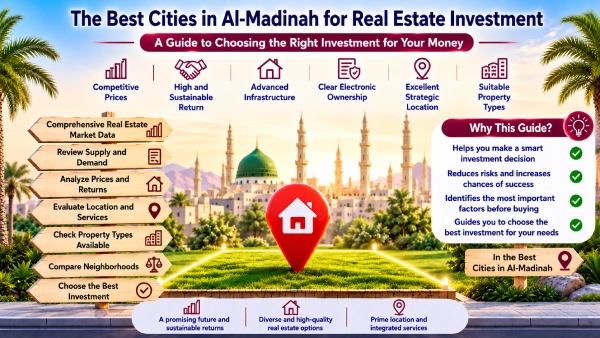
In this article, we review the best neighborhoods in Madinah for real estate investment, and how to compare prices, demand, services, title deeds, and neighborhood locations before buying an investment property, helping you choose the optimal way to invest your money.
The best neighborhoods in Madinah for investment are not a fixed list. The right neighborhood is determined by the entry price compared to executed transactions, sustained demand, infrastructure readiness, title deed validity, usage type, and ease of access to traffic axes. Therefore, the decision begins with data from the General Real Estate Authority, followed by inspection and verification of the property itself.
During the first quarter of 2025, the real estate market in the Madinah region recorded about 3,414 real estate transactions, with a value exceeding 2.7 billion Riyals, according to a report published by the Saudi Press Agency (SPA) on September 29, 2025. The trading included residential, commercial, and agricultural lands with a total area exceeding 4.6 million square meters.
These figures illustrate active real estate movement, but they do not mean every neighborhood or plot of land yields the same investment result. The success of a real estate investment in Madinah depends on the asset’s quality, purchase price, legal status, and actual demand, not just the neighborhood’s name.
محتوى المقال
How Do You Evaluate a Neighborhood for Real Estate Investment in Madinah?
To choose the best neighborhoods in Madinah for investment, you must first evaluate the investment neighborhood based on six interconnected elements: entry price, number of transactions, demand trend, infrastructure, title deed validity, and usage type. It is not enough for a neighborhood to be new or close to a known landmark if the purchase price is inflated or the services are incomplete.
1. Is the Entry Price Reasonable Compared to Executed Transactions?
The entry price is the primary factor determining your risk margin. Compare the property’s price with the average executed transactions for similar properties in the same neighborhood, not just with advertised asking prices.
The Real Estate Indicators Platform of the General Real Estate Authority provides sales and rental data at the region, city, and neighborhood levels, with filtering options by property type and timeframe.
When reviewing the price per square meter in Madinah, use the data in this order:
- Choose the neighborhood from the Real Estate Indicators Platform.
- Select the property type: residential land, commercial land, villa, or apartment.
- Choose a period of no less than 12 months (when data is available).
- Review the number of transactions alongside the average price per square meter.
- Exclude transactions that do not match in usage or area.
- Compare the result with the offered property price.
The average price per square meter alone can be misleading when the number of transactions is limited or when plot locations, areas, and street widths vary widely within the neighborhood.
2. How to Determine the Demand Trend in the Neighborhood?
The demand trend is measured by actual and continuous transaction movement, not by the number of published advertisements. An increase in ads could indicate demand, but it could also indicate oversupply and difficulty in selling.
Review the following indicators:
| Indicator | What it Reveals | The Signal Worth Studying |
| Number of Transactions | Liquidity level within the neighborhood | Transactions distributed over multiple periods |
| Transaction Value | Volume of traded funds | Value growth with steady transaction volume |
| Traded Area | Trading nature | Increases across diverse property sizes |
| Time on Market | Potential speed of sale | Shorter duration compared to alternatives |
| Most Traded Property Type | The demanded product | Target property matches existing demand |
| Offer vs. Execution Gap | Pricing realism | Asking prices align closely with recorded sales |
There is no single ratio to judge demand strength. You must compare the neighborhood against itself across different periods, then against neighborhoods offering a similar real estate product.
3. Is the Infrastructure Complete or Just Planned?
Complete infrastructure reduces time and unexpected costs, while newer areas require a stricter inspection of the condition of networks, roads, and facilities.
Physically verify:
- Electricity and the ability to issue a meter.
- Water network and connection feasibility.
- Sewage and the plot’s position relative to the network.
- Paving, lighting, and sidewalks.
- Master plan entrances and exits.
- Actually functioning schools and mosques.
- Parks and executed commercial services.
- Rainwater and flood drainage.
- Street width and approved usage.
The presence of a school or park on a master plan map does not necessarily mean it is built and operational at the time of purchase. Always distinguish between an existing service and land allocated for a future service.
4. What is the Importance of Proximity to the Haram and Growth Axes?
Practical proximity to the Prophet’s Mosque and main roads might increase the property’s appeal to some buyers, but it does not guarantee value appreciation or a specific return.
Verify the distance using the exact coordinates of the property itself, not the general neighborhood name. The Geospatial Real Estate Portal of the General Real Estate Authority displays data on cities, neighborhoods, land plots, and points of interest (educational, religious, health).
When comparing two locations, use the same destination and timing, then record:
- Actual physical distance.
- Travel time off-peak.
- Travel time during rush hour.
- Ease of entry and exit.
- Alternative routes.
- Distance to daily services.
- Distance to work or target commercial activity.
A plot on a clear path close to a main road might be more practical than a plot that looks closer on the map but sits behind limited entrances or uncompleted streets.
5. Why is the Electronic Title Deed (Sak) a Crucial Investment Element?
A clear title deed that exactly matches the property minimizes the risks of disruption in ownership transfer, building, or resale. You must verify the plot number, master plan, area, boundaries, and usage, matching them with the physical site.
The Ministry of Justice provides electronic services to inquire about real estate ownership documents. It also requires that city, neighborhood, plot, and master plan data be correct and match the documents when updating or modifying a deed.
Before paying a deposit, request:
- Electronic title deed data.
- Plot and master plan number.
- Area, boundaries, and dimensions.
- Approved usage type.
- Presence of any mortgage or restriction.
- The property’s status in the Real Estate Registry.
- Building permit (when buying a villa).
- Real estate advertising license.
- Broker or marketer authorization.
The mere existence of a deed does not replace checking its physical match with the land on the ground.
6. Is Residential or Commercial Land Better for Investment?
There is no absolute “better” type. Residential land targets the demand of families and residential developers, while commercial land relies on street strength, permitted usage, traffic volume, and surrounding activities.
| Land Type | Suitable For Whom? | Key Evaluation Element | Major Risks |
| Residential | Building or reselling to families | Residential demand & service readiness | Slow development or oversupply |
| Commercial | Commercial development or leasing | Street, traffic, and permitted use | High entry price & weak activity |
| Mixed-Use | Investor wanting more flexibility | Limits of legal usage | Misunderstanding regulations |
| Land in New Plan | Medium/long-term holding | Actual infrastructure execution | Delayed services & development |
| Ready-to-Build | Building or relatively fast resale | Permits and utilities | Buying land above its true value |
Before selecting investment lands in Madinah, define your exit strategy: Will you sell the land as is, build on it, develop it, or hold it long-term? The suitable land type changes based on your answer.
Which Neighborhoods Have Investment Demand in Madinah?
When studying the best neighborhoods in Madinah for investment, you must identify neighborhoods with high demand, which will help you in selling or leasing later for a higher return.
There is no fixed official list that can be described as the “best neighborhoods” at all times. Neighborhood rankings change based on the period, property type, transaction volume, entry price, and service completion.
| Neighborhood Category | What Attracts the Investor? | Data to Review | Potential Risk Level |
| Mature, Fully Serviced | Clear residential demand & liquidity | Price/m², transaction volume, rents | High entry price |
| Urban Expansion Area | Entry before full growth | Road/utility execution, building activity | Delayed service completion |
| Near Main Axis | Ease of movement & usage appeal | Street width & traffic connectivity | Value disparity within the neighborhood |
| Near the Haram | Demand from specific segments | Actual distance & product type | Price overvaluation |
| New Plan (Ready Deeds) | Product clarity & building ability | Deeds, services, and permits | Limited historical data |
| On a Commercial Street | Development or commercial opportunity | Usage, density, and traffic | High entry and development costs |
How to Use the Table to Identify Suitable Neighborhoods
Start by selecting five neighborhoods from the Real Estate Indicators Platform based on the highest activity for your target property type over the last 12 months. Then, exclude any neighborhood that does not fit your budget or strategy, and compare the remaining ones using the same criteria.
Create a table including:
- Number of transactions.
- Average price per square meter.
- Lowest and highest recorded price.
- Traded area.
- Most active property type.
- Completed services.
- Road conditions.
- Number of competing offers.
- Exit plan.
- Specific risks for each location.
Is Real Estate Investment in Madinah Active?
Published data indicates diverse trading movement in the Madinah market, but general market activity does not guarantee the success of every single transaction.
During 2025, 89 real estate auctions were held in Madinah, involving the sale of 384 real estate assets valued at nearly 989 million Riyals, according to SPA data published in June 2026. Auction sales represented about 10.4% of total real estate transaction value in the city during that period.
This data is useful for measuring trading volume and general liquidity, but it cannot be used to estimate a specific property’s return or predict the appreciation of a particular plot. The decision must remain tied to the specific property, its price, location, and documents.
Why Do Modern Neighborhoods Like Al-Jassah Attract Investors?
Modern areas are often considered among the best neighborhoods in Madinah for investment because they offer new master plans, diverse land options, and a chance to enter during urban expansion phases. However, a modern area does not automatically become a successful opportunity; you must inspect service completion, building activity, entry price, and resale viability.
What is Worth Evaluating in the Al-Jassah Neighborhood?
Al-Jassah deserves study when a plot combines a clear title deed, actual services, practical road access, and the appropriate usage type.
Rawafed’s pages state that its projects in Al-Jassah include services such as electricity, water, sewage, schools, mosques, parks, parking lots, and pedestrian walkways. This is published project data, and the readiness of each service must be verified at the specific plot being purchased.
Rawafed also publishes estimated travel times from its projects:
- 25 minutes to the Prophet’s Mosque.
- 20 minutes to Quba Mosque.
- 20 minutes to Haramain Train Station.
- 25 minutes to Prince Mohammad bin Abdulaziz Airport.
- 15 minutes to King Fahd Park.
These times are estimates published by Rawafed, not fixed official times for all parts of Al-Jassah. They should be remeasured from the specific plot’s location at different times before making a decision.
How Does Al-Jassah Align with Investment Criteria?
| Evaluation Criterion | What do Rawafed Projects Offer? | What Must You Verify? |
| Asset Clarity | Land options within a specific plan | Plot number, deed, and master plan |
| Usage Type | Residential lands & options | Approved usage for each plot |
| Access | Located near Jaber bin Ateeq St. | Actual routes and alternative roads |
| Services | Multiple announced project services | Existing service at the specific plot |
| Street | Options on various streets | Street width and facade |
| Buildability | Lands within a modern plan | Building regulations and permits |
| Resale | Product within a known project | Demand and competing transactions |
| Entry Price | Licensed offer prices for available plots | Compare with REGA transactions |
It is not enough that the land is in Al-Jassah. A plot on a commercial street or near a clear entrance might differ entirely as an investment from an internal plot, even within the same neighborhood.
What is the Practical Step to Evaluate Rawafed Lands?
Review investment lands in the Al-Jassah neighborhood, then request a file for each plot containing the title deed, location, area, facade, street width, usage type, services, and licensed price.
(You can view the Ruba Al-Bashaer master plan to compare available plots based on their location within the plan, not just their total price).
What Are the Common Mistakes When Choosing a Neighborhood for Investment?
The most common mistake is buying a property based on a general expectation that the neighborhood will witness growth. Urban growth does not necessarily translate to profit if the entry price is too high or liquidity is weak.
- Relying purely on the neighborhood name: Prices and services vary within the same neighborhood from one street to another. Study the plot, plan, facade, and entrance, not just the neighborhood name.
- Directly comparing asking price to market average: Asking price is not an executed transaction. Compare with similar transactions in usage, area, and timeframe.
- Ignoring the number of transactions: A high average price based on one or two sales does not reflect a stable trend.
- Assuming all announced services are complete: Request proof that electricity, water, sewage, and paving have reached the specific plot.
- Not checking the deed and usage: The land might be residential while your plan requires commercial use, or there may be differences between physical location and document data.
- Buying without an exit plan: Decide before buying who the expected future buyer is: a family, developer, trader, investor, or commercial enterprise.
- Expecting guaranteed returns or price doubling: There is no guaranteed return percentage or fixed timeframe for land appreciation. Use multiple scenarios including price stagnation, long selling times, or increased development costs.
What Must a Non-Saudi Buyer Review Before Investing?
Non-Saudis must verify the geographical zones and regulations applied to the specific property via the Non-Saudi Real Estate Ownership Law portal (General Real Estate Authority).
The updated law clarifies that ownership occurs within specific geographic zones and regulatory controls. The property being in Madinah does not mean ownership is automatically available to everyone or in every location.
Verification must occur before:
- Paying a deposit.
- Signing a booking.
- Transferring any funds.
- Entering an investment agreement.
- Relying on a marketer’s description.
- Arranging financing or a partnership.
What is the Final Checklist Before Buying an Investment Property?
Use this checklist before making your decision:
- [ ] Extracted the latest neighborhood data from REGA.
- [ ] Reviewed transaction volume, not just average price.
- [ ] Compared the property with similar transactions.
- [ ] Verified the electronic title deed.
- [ ] Matched location, boundaries, and area.
- [ ] Reviewed the permitted usage type.
- [ ] Confirmed actual, existing services.
- [ ] Measured distances from the plot location.
- [ ] Checked street width and facade orientation.
- [ ] Reviewed building regulations and permits.
- [ ] Estimated development and holding costs.
- [ ] Created three exit scenarios.
- [ ] Conducted a field inspection.
- [ ] Consulted a licensed appraiser or advisor if needed.
Frequently Asked Questions About the Best Neighborhoods in Madinah for Investment
Is real estate in Madinah a good investment?
Real estate investment in Madinah can be highly suitable when the entry price is supported by actual transactions, the title deed is clear, services are complete, and there is existing demand for that specific property type. General market activity does not guarantee a profit on every deal.
What is the best type of land for investment?
The right type depends on your strategy. Residential land is suited for building or reselling to families and developers. Commercial land relies on street strength, traffic, legal usage, and development costs.
How do I know the demand trend for a specific neighborhood?
Review the number, value, and area of transactions over consecutive periods on the REGA platform, then compare them with the number of offers and the most traded property type. Do not rely solely on the average price per square meter.
Does proximity to the Prophet’s Mosque guarantee property appreciation?
No. Proximity may increase appeal, but value is also affected by purchase price, services, roads, title deed, usage type, property quality, and supply vs. demand.
Can a non-Saudi buy property in Madinah?
This is subject to the Non-Saudi Real Estate Ownership Law and approved geographical zones and regulations. You must verify eligibility via the General Real Estate Authority portal before booking or paying any amount.
Conclusion
Choosing the best neighborhoods in Madinah for investment starts with data, not impressions. Look for a neighborhood that combines a logical entry price, actual demand, complete services, a clear title deed, and practical access, then move on to evaluate the plot itself.
Modern neighborhoods like Al-Jassah may offer an entry opportunity into a developing urban zone, but investment value is not measured by the neighborhood’s newness alone. It is measured by how well the purchase price aligns with actual transactions, service readiness, and the property’s suitability for building or resale.
Rawafed offers land options within the Al-Jassah neighborhood and the Ruba Al-Bashaer master plan, allowing you to review the location, deed, services, and facades before booking.
Contact Rawafed and request an investment comparison between available plots to make an informed, data-driven decision.
Contact Via Whatsapp

Join The Discussion